Preparing for SQE1 is not simply a question of learning as much law as possible. The examination is designed to test functioning legal knowledge, which means candidates must recognise the relevant legal principle, apply it to a realistic client scenario and select the single best answer from five plausible alternatives. Success therefore depends on understanding the official assessment blueprint, allocating revision time sensibly and knowing which rules deserve attention during the final days before the examination.
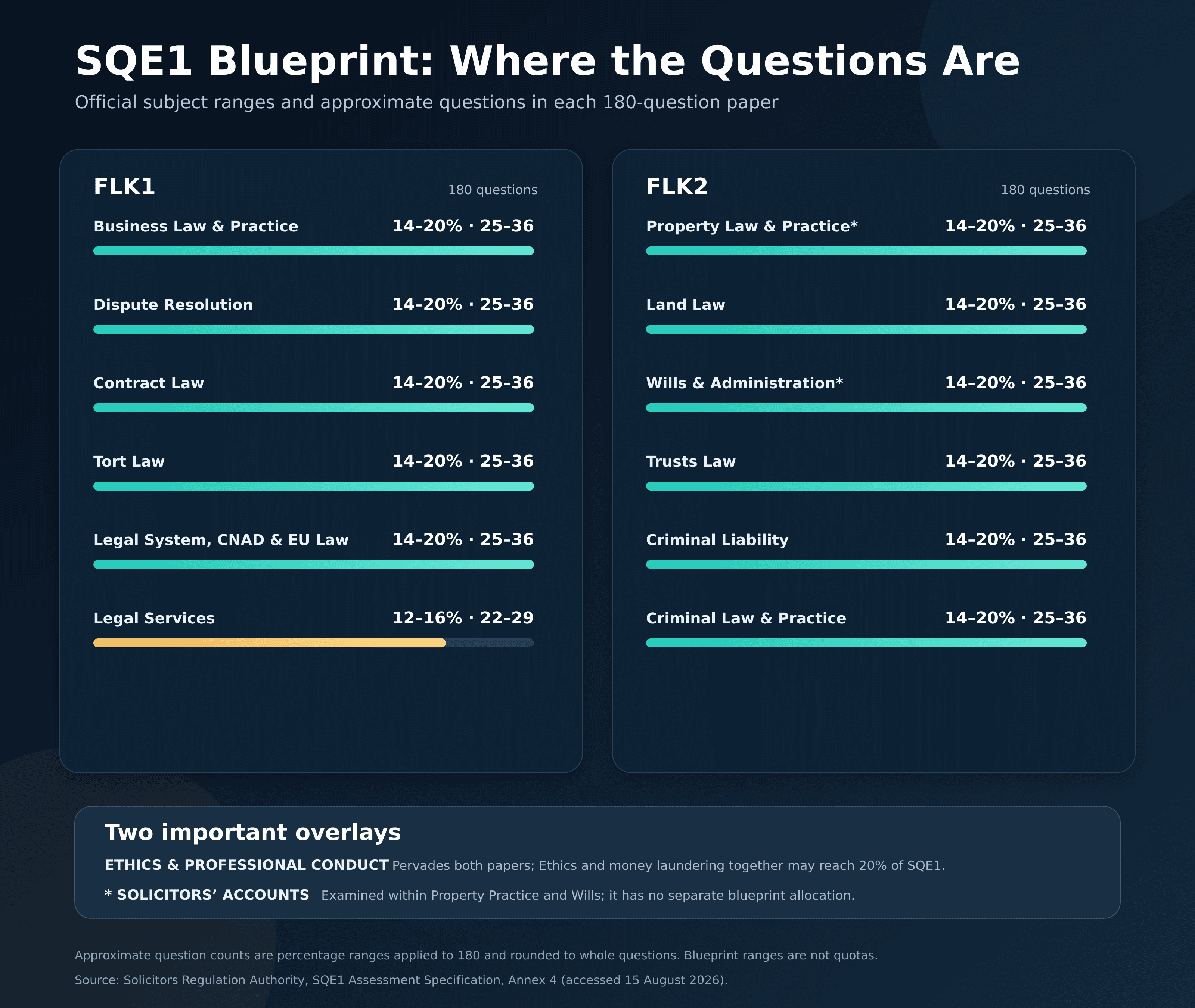
SQE1 comprises two assessments, FLK1 and FLK2, each containing 180 single-best-answer questions. Each assessment is divided into two sessions of 90 questions. FLK1 examines Business Law and Practice, Dispute Resolution, Contract Law, Tort Law, the Legal System of England and Wales, Constitutional and Administrative Law, EU law and Legal Services. FLK2 examines Property Law and Practice, Land Law, Wills and the Administration of Estates, Trusts, Criminal Liability and Criminal Law and Practice. Solicitors’ Accounts is tested within Property Law and Practice and Wills and the Administration of Estates, rather than receiving a completely separate allocation.
The Solicitors Regulation Authority uses a system called single best classification. Each question is allocated to the subject that represents its primary focus, but that does not mean subjects exist in isolation. A question classified as Contract Law may require knowledge of limitation or civil procedure. A Property Practice question may also test conflicts of interest, money laundering or the SRA Accounts Rules. A Criminal Practice question may depend on understanding the elements of an offence. Consequently, a subject allocated 14–20 per cent may influence considerably more than 20 per cent of the paper.
Most of the principal subjects account for 14–20 per cent of their respective paper. In a 180-question assessment, this corresponds to approximately 25–36 questions. These ranges are not predictions of an exact number in every sitting. They give the assessment provider flexibility while ensuring adequate coverage. Legal Services has a slightly smaller allocation of 12–16 per cent of FLK1, approximately 22–29 questions. Ethics and Professional Conduct pervades both assessments rather than appearing as an isolated block.
The official SRA blueprint should therefore be the foundation of any revision plan. Textbooks, courses and question banks are valuable only to the extent that they teach candidates to apply the material contained in that blueprint.
Business Law and Practice
Business Law and Practice represents 14–20 per cent of FLK1. The subject follows the life of a business from formation to finance, management, taxation and insolvency. Candidates must compare sole traders, partnerships, LLPs, private companies and unlisted public companies, understanding the consequences of separate legal personality, limited liability, taxation and management structure.
The highest-value revision lies in company decision-making. Candidates should know which decisions belong to directors and which require shareholders, the difference between ordinary and special resolutions, the rules governing board meetings, written resolutions and general meetings, and the procedures for appointing and removing directors. The statutory duties in sections 171–177 of the Companies Act 2006 should be known accurately. Questions commonly become easier once the candidate identifies whose approval is required, what majority applies and whether an interested director can vote.
Share allotments, pre-emption rights, dividends, fixed and floating charges, registration of security and minority shareholder remedies also deserve careful attention. The insolvency component should be approached as a sequence: identify insolvency, choose the appropriate procedure, determine whether a pre-insolvency transaction is vulnerable and apply the order of distribution.
Taxation is broad, but last-minute revision should concentrate on recognising which tax applies and how the basic calculation works. Candidates should distinguish Income Tax, Capital Gains Tax, Corporation Tax, VAT and Business Property Relief. From September 2026, the specification expressly confirms that share redemption, company buybacks and the calculation of company income profits and chargeable gains are within scope.
Dispute Resolution
Dispute Resolution represents 14–20 per cent of FLK1 and is one of the most procedurally exact subjects. It covers the progression of a civil dispute from initial advice to enforcement. Candidates must compare litigation, mediation and arbitration, assess limitation, comply with pre-action obligations, commence and serve proceedings, respond to a claim, manage evidence and disclosure, prepare for trial, advise on costs and enforce judgment.
The best investment of revision time is the procedural timeline. Candidates should know when a contract or tort claim becomes time-barred, how and when a claim form must be served, when an acknowledgment of service or defence is due, and when default judgment is available. They should distinguish actual service from deemed service and understand the effect of weekends and procedural extensions.
The tests for summary judgment, interim injunctions, interim payments and relief from sanctions are also highly valuable. Disclosure should be reviewed through practical distinctions: disclosure versus inspection, standard versus specific disclosure, and confidentiality versus privilege. Part 36 offers deserve particular attention because a short factual alteration can reverse the costs consequences. Enforcement questions become manageable when the candidate matches the debtor’s asset to the remedy, such as goods, earnings, land or money held by a bank.
In the final review, dates, procedural tests, costs consequences and enforcement methods are more valuable than reading lengthy descriptions of litigation theory.
Contract Law
Contract Law represents 14–20 per cent of FLK1. It covers formation, contractual parties, terms, vitiating factors, discharge, remedies, causation and remoteness.
Formation should be revised as a disciplined sequence: offer, acceptance, consideration, intention, certainty and capacity. Candidates should distinguish an offer from an invitation to treat, a counter-offer from a request for information and acceptance from continuing negotiation. The postal rule, unilateral contracts, revocation and acceptance by conduct are recurring sources of plausible distractors.
The next priority is contractual terms. Candidates need to know how terms are incorporated by signature, notice or previous dealings, when terms are implied and whether a term is a condition, warranty or innominate term. From September 2026, interpretation and classification of terms are expressly separated in the blueprint. Exclusion clauses should be analysed in order: incorporation, interpretation, common-law controls, the Unfair Contract Terms Act 1977 and the Consumer Rights Act 2015.
Misrepresentation, mistake, duress and undue influence should be distinguished by their legal tests and remedies. For breach, candidates should ask whether termination is available, whether the innocent party has affirmed and which damages follow. The final review should concentrate on expectation damages, reliance loss, remoteness under Hadley v Baxendale, mitigation, penalty clauses and the availability of specific performance or injunctions.
Tort Law
Tort Law represents 14–20 per cent of FLK1. The largest component is negligence, followed by pure economic loss, psychiatric harm, employers’ liability, vicarious liability, occupiers’ liability, product liability, nuisance and Rylands v Fletcher.
Negligence should be applied in a fixed order: duty, breach, factual causation, legal causation, remoteness, actionable loss and defences. Candidates should recognise established duties before reaching for the full Caparo analysis. For breach, the most useful factors are the probability and seriousness of harm, the practicality of precautions and the social value of the activity.
Professional negligence requires familiarity with Bolam, Bolitho and, in clinical advice, Montgomery. Causation requires more than the “but for” test. Candidates should distinguish material contribution to injury from material increase in risk and recognise that loss-of-chance recovery is restricted in personal injury.
Pure economic loss should be separated from consequential loss. Psychiatric injury requires differentiation between primary and secondary victims. Employers’ personal duties should not be confused with vicarious liability. Occupiers’ Liability Act 1957 questions concern visitors, whereas the 1984 Act principally protects non-visitors under a more restricted test. Last-minute revision should focus on these distinctions, together with contributory negligence, volenti and illegality.
The Legal System, Constitutional and Administrative Law and EU Law
The Legal System of England and Wales, sources of law, Constitutional and Administrative Law and EU law collectively represent 14–20 per cent of FLK1. They do not each receive a separate 14–20 per cent allocation.
For the Legal System, candidates should know the civil and criminal court hierarchy, jurisdiction, judicial function, rights of audience and doctrine of precedent. The practical questions are whether a decision binds another court, whether a statement is ratio or obiter and whether an earlier decision can be distinguished, overruled or treated as per incuriam.
Statutory interpretation is particularly suitable for last-minute review. Candidates should recognise the literal, golden, mischief and purposive approaches, together with presumptions, internal aids and external materials such as Law Commission reports and parliamentary statements under Pepper v Hart. They should also understand commencement, extent and application, particularly where legislation applies differently in England and Wales.
Constitutional Law should be revised around parliamentary sovereignty, separation of powers, rule of law, prerogative powers, devolution and the relationship between Westminster and Senedd Cymru. Administrative Law is dominated by judicial review. Candidates should know amenability, standing, the prompt three-month time limit, alternative remedies, permission, illegality, irrationality, procedural impropriety, legitimate expectation and the available remedies.
Human Rights Act questions should be approached through sections 2, 3, 4, 6, 7, 8 and 10. Candidates must distinguish absolute, limited and qualified Convention rights and apply proportionality to qualified rights. EU law remains relevant through the Withdrawal Agreement and retained or assimilated law, but candidates must not answer as though the United Kingdom were still an EU Member State.
Legal Services
Legal Services represents 12–16 per cent of FLK1, approximately 22–29 questions. It covers the SRA’s regulatory role, money laundering, financial services and funding legal work.
The highest-yield material includes reserved legal activities, authorisation, client care, complaints, conflicts, confidentiality and available funding models. Candidates should recognise when conduct falls within a regulated financial activity and whether a professional-firm exemption may apply.
Money laundering deserves substantial attention because it combines technical legislation with professional judgment. Candidates should know customer due diligence, beneficial ownership, enhanced due diligence, politically exposed persons, source of funds, source of wealth, suspicious activity reports, privileged circumstances and tipping off. The correct answer often depends on sequencing: stop, report internally, allow the nominated officer to decide whether an external report is required and avoid revealing that a report has been made.
Property Law and Practice
Property Law and Practice, including Solicitors’ Accounts in a conveyancing context, represents 14–20 per cent of FLK2.
Candidates should understand the chronology of a freehold or leasehold transaction from instructions to post-completion registration. Investigation of title is central. They should interpret the Property, Proprietorship and Charges Registers, identify title defects, distinguish notices from restrictions and recognise when further enquiries, insurance, consent or a deed are required.
Searches should be learned by purpose rather than name alone. The candidate should know which problem a local authority, drainage, environmental, mining, highways or bankruptcy search is designed to reveal. Acting for buyer and lender requires knowledge of the lender’s interests and the certificate of title. A buyer who refuses permission to disclose material information may force the solicitor to cease acting for both parties.
Exchange, deposits, insurance, pre-completion searches, transfer deeds, completion and registration are particularly high yield. Commercial lease questions require knowledge of repair, rent review, alienation, assignment, authorised guarantee agreements, remedies for breach and security of tenure under the Landlord and Tenant Act 1954. Candidates should also distinguish SDLT in England from LTT in Wales and understand VAT, the option to tax and Private Residence Relief.
Solicitors’ Accounts
Solicitors’ Accounts has no standalone percentage because it is assessed within Property Practice and estate administration. Candidates must distinguish client money from business money and apply double-entry bookkeeping.
The final review should concentrate on a small set of dependable principles. Money for unbilled fees is ordinarily client money. A bill or written notification must be delivered before billed costs are transferred to business account. Client money must be used only for the purpose for which it is held, and the particular client ledger must contain sufficient funds. One client’s money must never finance another client’s matter.
Candidates should memorise the basic entries for receiving and paying client money, receiving business money, delivering a bill and transferring billed costs. They should distinguish agency from principal disbursements and understand the VAT consequences. Reconciliations must be conducted at least every five weeks, and breaches must be corrected promptly upon discovery.
Land Law
Land Law represents 14–20 per cent of FLK2. It concerns ownership and enforceability rather than the practical conveyancing process.
The first priority is registered land. Candidates should know registrable dispositions, notices, restrictions, overriding interests and actual occupation. Overreaching should be understood precisely: payment of capital money to at least two trustees or a trust corporation detaches the beneficial interest from the land and transfers it to the proceeds.
For unregistered land, candidates should revise the Land Charges classes and the residual doctrine of notice. Co-ownership requires distinction between legal and beneficial ownership, joint tenancy and tenancy in common, survivorship, severance and applications under sections 14 and 15 TOLATA.
Easements should be approached through the Re Ellenborough Park requirements and the methods of creation, particularly necessity, common intention, Wheeldon v Burrows, section 62 and prescription. Candidates must distinguish positive from restrictive freehold covenants and understand how their benefit and burden pass. Mortgages, the equity of redemption, undue influence, possession and the mortgagee’s power of sale are also important. Lease questions require differentiation between a lease and licence and between pre-1996 and post-1995 covenant liability.
Wills and the Administration of Estates
Wills and the Administration of Estates, including relevant Solicitors’ Accounts, represents 14–20 per cent of FLK2.
Candidates should first master validity: testamentary capacity, knowledge and approval, absence of undue influence and section 9 execution formalities. Revocation by later will, destruction, marriage or civil partnership should be distinguished from the effect of divorce, which generally treats the former spouse as having predeceased the testator without revoking the entire will.
The interpretation of gifts requires familiarity with lapse, ademption, abatement and section 33 of the Wills Act 1837. Intestacy should be applied as a strict statutory order. A cohabitant does not inherit as a spouse merely because the relationship was long.
For probate, candidates must distinguish executors from administrators and identify the correct grant and person with priority. Inheritance Tax revision should focus on potentially exempt transfers, chargeable lifetime transfers, gifts with reservation, spouse and charity exemptions, the nil-rate bands and principal business or agricultural reliefs.
Estate administration questions commonly test personal representatives’ duties, creditor notices, missing beneficiaries, premature distribution and 1975 Act claims. The ordinary time limit for such a claim is six months from the grant. Section 27 Trustee Act advertisements protect personal representatives against certain unknown claims but do not extinguish the underlying creditor’s rights.
Trusts
Trusts represents 14–20 per cent of FLK2. The strongest foundation is the three certainties: intention, subject matter and objects. Fixed trusts require a complete list, while discretionary trusts use the “is or is not” test.
Candidates should know the formalities under section 53 LPA 1925 and distinguish creation from constitution. Equity does not ordinarily perfect an imperfect gift, but the recognised principles in Re Rose, Strong v Bird and Choithram v Pagarani are expressly identified from September 2026.
Beneficial entitlement requires understanding vested, contingent, fixed and discretionary interests and the rule in Saunders v Vautier. Resulting trusts should be separated into automatic and presumed categories. Family-home problems require common-intention constructive trusts and proprietary estoppel.
Trustee duties are highly examinable: investment, care, impartiality, proper purpose, avoidance of conflict and unauthorised profit. Breach questions may involve equitable compensation, account of profits, section 61 relief, limitation, knowing receipt or dishonest assistance. Tracing questions should distinguish following from tracing, personal from proprietary remedies and apply the mixed-fund and lowest-intermediate-balance rules.
Criminal Liability
Criminal Liability represents 14–20 per cent of FLK2. It is separate from Criminal Law and Practice. The specified offences include offences against the person, theft, robbery, burglary, aggravated burglary, criminal damage, homicide and fraud.
The most efficient approach is to learn every offence through actus reus, mens rea and any specific statutory requirements. For non-fatal offences, candidates should distinguish assault, battery, section 47, section 20 and section 18. For theft offences, dishonesty, appropriation, property, belonging to another and intention permanently to deprive must be applied accurately.
Homicide revision should separate murder, loss of control, diminished responsibility, unlawful-act manslaughter and gross-negligence manslaughter. Fraud requires distinction between false representation, failure to disclose and abuse of position. Candidates should also review intoxication, self-defence, principal and secondary participation and attempts.
The final review is best spent comparing offences that share similar facts but differ through one element, such as section 20 and section 18, theft and robbery, or burglary and aggravated burglary.
Criminal Law and Practice
Criminal Law and Practice represents 14–20 per cent of FLK2 and follows the case from police station to appeal.
At the police station, candidates should know the right to free legal advice, the right to have someone informed, detention limits, reviews, appropriate adults, identification procedures and interview requirements under PACE. Advice on silence must account for possible adverse inferences.
The next priority is bail. Candidates should identify the statutory exception relied upon, propose proportionate conditions and distinguish breach of a bail condition from the separate offence of failing to surrender.
Classification of offences drives the first hearing. Candidates should distinguish summary-only, either-way and indictable-only offences, plea before venue, allocation and sending to the Crown Court. Evidence questions require familiarity with Turnbull identification directions, hearsay gateways, confession evidence under section 76 PACE, discretionary exclusion under section 78 and bad-character gateways.
Sentencing should be revised as a structured process involving culpability, harm, aggravating and mitigating factors, guilty-plea credit, totality and the appropriate sentence. Newton hearings, appeals from magistrates to the Crown Court, case stated appeals and Crown Court appeals to the Court of Appeal should be distinguished. Youth Court procedure should be reviewed separately.
Ethics and Professional Conduct
Ethics pervades every subject and may decide the answer even where the question appears primarily procedural or substantive.
The seven SRA Principles should be memorised exactly. Candidates should understand that duties protecting the rule of law, administration of justice, honesty, integrity and public confidence may override the wishes or immediate interests of an individual client.
The highest-yield areas are own-interest conflicts, client conflicts, confidentiality, disclosure of material information, legal professional privilege, duties to the court, undertakings, client money, competence, supervision and regulatory reporting. Candidates should recognise the limited exceptions allowing a solicitor to act where clients have a substantially common interest or compete for the same objective.
A practical ethical sequence is invaluable. Identify the client, identify the duty, determine whether disclosure is permitted or required, advise the client, seek informed consent where lawful, refuse an improper instruction, cease acting where the problem cannot be resolved and report only where a legal or regulatory duty requires it.
What Is Most Worth Revising at the Last Moment?
Last-minute revision should not attempt to relearn the entire syllabus. Its purpose is to secure rules that are easily forgotten, frequently confused and capable of changing the answer immediately.
The highest return comes from procedural deadlines, statutory tests, numerical thresholds, decision-making majorities, priority orders and legal distinctions. Review civil limitation and service deadlines, criminal detention periods, judicial-review timing, probate claim limits, company-resolution thresholds, charge-registration periods and the sequence of estate or insolvency distribution. These are rules for which approximate knowledge is rarely sufficient.
Next, revise pairs of concepts that produce plausible distractors: condition versus warranty, assignment versus novation, notice versus restriction, joint tenancy versus tenancy in common, executor versus administrator, PET versus chargeable lifetime transfer, client money versus business money, breach of bail versus failure to surrender, section 76 versus section 78 PACE, and knowing receipt versus dishonest assistance.
The final hours should be devoted to compact decision frameworks. For negligence, use duty, breach, causation, remoteness, loss and defences. For contract, use formation, terms, vitiating factor, discharge and remedy. For civil procedure, identify stage, deadline, document, test and costs consequence. For property, identify jurisdiction, tenure, registration status, transaction stage and required protection. For criminal practice, identify stage, offence classification, court, evidence rule and remedy. For ethics, identify client, conflict, confidentiality, overriding duty and required next action.
Do not spend the last evening reading entire chapters passively. Use short questions, answer before seeing the options and explain why each alternative is wrong. SQE1 rewards discrimination between closely related rules. The candidate who can explain why four answers fail is less vulnerable to a carefully drafted distractor than the candidate who merely recognises one familiar phrase.
Finally, protect examination performance. Stop trying to expand the syllabus, consolidate the rules already learned and arrive rested enough to apply them. The examination is not designed to reward encyclopaedic recall. It rewards the disciplined selection of the rule that a competent newly qualified solicitor would apply to the facts presented. The best final revision is therefore not the widest revision. It is the revision that makes the most important rules precise, accessible and ready for immediate application.