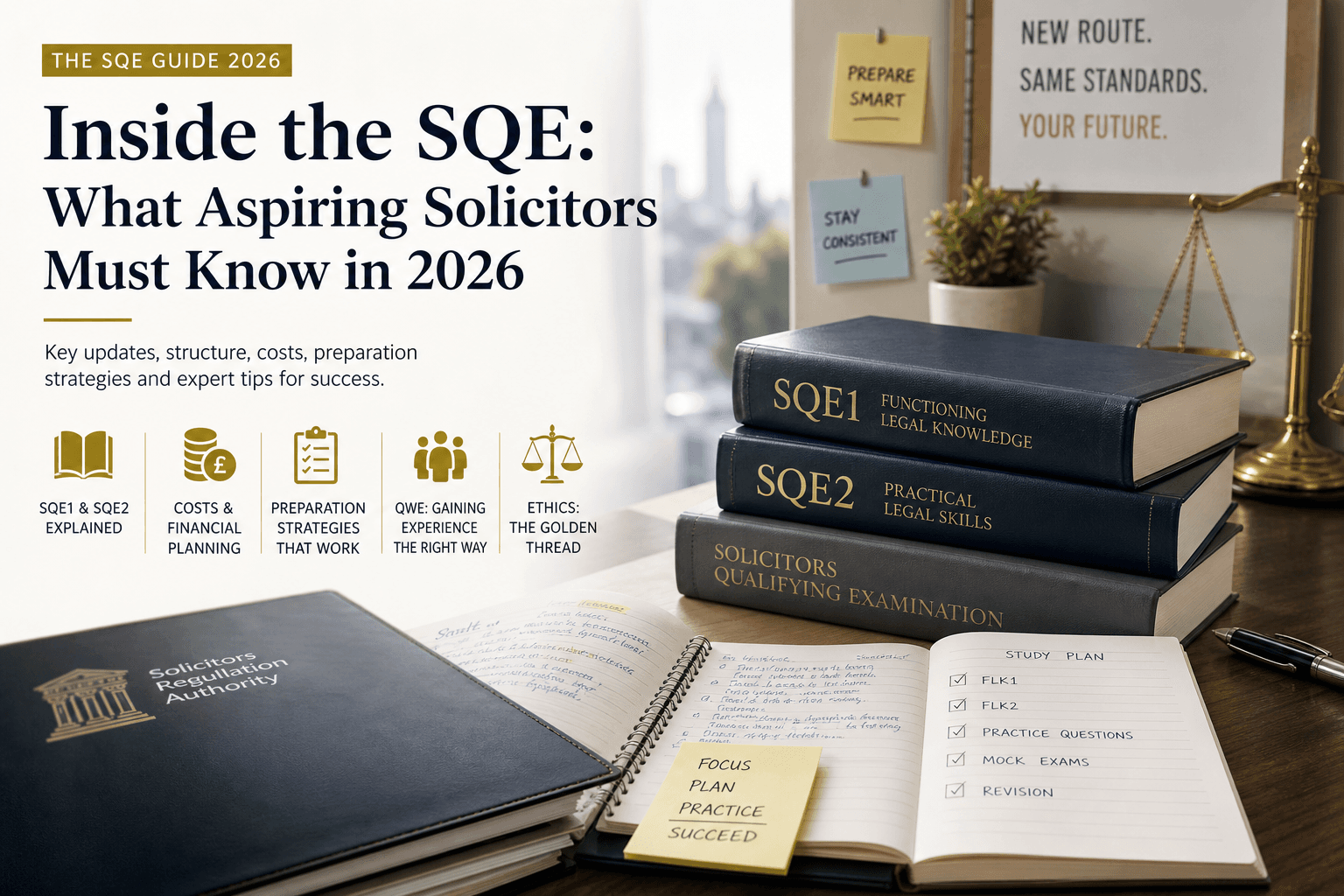
A New Era in Legal Qualification
The route to qualification as a solicitor in England and Wales has undergone one of the most significant reforms in decades. The introduction of the Solicitors Qualifying Examination (SQE) has replaced the traditional Legal Practice Course (LPC), promising a more centralised, consistent, and—at least in theory—accessible pathway into the profession.
Yet, as the SQE enters its more mature phase, candidates are discovering that accessibility does not necessarily equate to simplicity. The examination regime is rigorous, the preparation demanding, and the strategic decisions surrounding it increasingly complex.
For aspiring solicitors in 2026, understanding the SQE is not merely a matter of knowing its structure. It requires a deeper appreciation of how the system operates in practice: the expectations of the Solicitors Regulation Authority (SRA), the realities of pass rates, the financial implications, and the evolving strategies that distinguish successful candidates from the rest.
The Structure: Two Assessments, One Standard
The SQE is divided into two stages: SQE1 and SQE2. While this division appears straightforward, the intellectual demands of each stage differ markedly.
SQE1: Functioning Legal Knowledge
SQE1 is often underestimated. It consists of two lengthy multiple-choice assessments—FLK1 and FLK2—each designed to test not merely recall, but the application of legal principles across a wide range of subjects.
Candidates must demonstrate competence in areas such as:
- Contract and tort
- Criminal law and practice
- Property law
- Business law and dispute resolution
- Trusts, wills, and ethics
The challenge lies not in the breadth alone, but in the style of questioning. The SRA’s Single Best Answer (SBA) format demands precision. Each option may appear plausible; only one is defensible.
Many candidates describe SQE1 as a test of discipline as much as knowledge. Time management, pattern recognition, and resilience under pressure are essential.
SQE2: Practical Legal Skills
If SQE1 tests what you know, SQE2 tests what you can do.
Here, candidates are assessed on practical skills, including:
- Client interviewing and attendance notes
- Advocacy
- Legal research and writing
- Drafting
- Case and matter analysis
The emphasis shifts from theoretical correctness to professional competence. Candidates must think, write, and communicate like solicitors.
Notably, SQE2 assumes that candidates have already mastered the underlying law. Weaknesses in SQE1 knowledge often resurface here, particularly in written tasks.
The Cost Question: Access vs Reality
One of the SRA’s stated aims in introducing the SQE was to reduce barriers to entry. The reality, however, remains contested.
As of 2026, the cost of:
- SQE1 sits at over £1,600
- SQE2 exceeds £2,700
These figures exclude preparation courses, which can range from a few hundred pounds for self-study materials to several thousand for comprehensive programmes.
For many candidates, the financial burden remains substantial. While some firms sponsor their future trainees, a significant proportion of candidates self-fund, often with no guarantee of success.
The debate continues: has the SQE truly widened access, or merely redistributed cost?
Pass Rates and the Myth of Predictability
Perhaps the most discussed aspect of the SQE is its pass rates.
SQE1, in particular, has proven challenging. Pass rates have fluctuated, often hovering around the 50–60% mark. This unpredictability has led to growing concern among candidates.
Unlike traditional university assessments, SQE results are standardised across sittings. This means:
- The difficulty of questions may vary
- The pass mark is adjusted accordingly
For candidates, this introduces an element of uncertainty. Preparation must therefore aim not at scraping through, but at achieving consistent, high-level performance.
Work Experience: Flexibility with Consequences
A defining feature of the SQE is the introduction of Qualifying Work Experience (QWE).
Unlike the traditional training contract, QWE:
- Can be completed in up to four organisations
- Includes roles such as paralegal work or law clinic experience
- Does not require formal recruitment cycles
This flexibility is widely welcomed. It allows candidates to build experience in diverse settings and at different stages of their careers.
However, it also introduces new challenges:
- Not all QWE is equal in quality
- Candidates must be proactive in ensuring meaningful exposure
- Verification requirements add administrative complexity
In short, the responsibility has shifted from firms to candidates.
Ethics: The Thread Running Through Everything
One of the most striking features of the SQE is the prominence of ethics.
Professional conduct is not confined to a single module. It permeates:
- Multiple-choice questions in SQE1
- Practical scenarios in SQE2
Candidates must demonstrate not only knowledge of the rules, but the ability to apply them in nuanced, real-world situations.
This reflects a broader shift in legal education: competence is no longer measured solely by technical ability, but by professional judgment.
Preparation Strategies: What Actually Works
In the growing SQE preparation market, candidates are confronted with an overwhelming array of options.
While there is no single formula for success, certain principles consistently emerge.
1. Active Learning Over Passive Reading
Reading textbooks is not enough. The SQE demands application. Practice questions, scenario analysis, and timed exercises are indispensable.
2. Early Integration of Topics
Subjects do not exist in isolation. Contract law may appear in business scenarios; criminal law may intersect with evidence and procedure.
Successful candidates learn to think across topics.
3. Time Discipline
SQE1, in particular, is unforgiving. Candidates must develop the ability to:
- Read quickly
- Identify key facts
- Eliminate distractors efficiently
4. Ethical Awareness
Ethics questions often turn on subtle distinctions. Regular exposure to ethical scenarios is essential.
Common Pitfalls
Despite careful preparation, many candidates fall into predictable traps.
- Over-reliance on memorisation
- Failure to practise under exam conditions
- Neglecting weaker subjects
- Misinterpreting the “single best answer” format
Perhaps the most dangerous mistake is underestimating the exam.
The Role of Law Firms
For candidates aiming for commercial practice, the role of law firms remains central.
Many firms:
- Sponsor SQE preparation
- Integrate SQE study into training programmes
- Offer structured support
However, competition is intense. The SQE has not diminished the importance of securing a training contract; if anything, it has heightened it.
Diversity and Inclusion: Progress or Illusion?
The SQE was introduced partly to address concerns about diversity in the legal profession.
There are signs of progress:
- Greater flexibility in work experience
- Increased access to self-study routes
Yet challenges remain:
- Financial barriers persist
- Access to high-quality preparation varies
- Socio-economic disparities continue to influence outcomes
The long-term impact of the SQE on diversity is still unfolding.
Looking Ahead: The Future of the SQE
As the SQE evolves, several trends are emerging:
- Greater standardisation of preparation materials
- Increased data transparency from the SRA
- Refinement of assessment methods
There is also growing discussion about:
- The balance between accessibility and rigour
- The role of universities in SQE preparation
- The potential for further reform
Conclusion: A Demanding but Defining Challenge
The SQE represents more than a new examination. It is a redefinition of what it means to qualify as a solicitor.
For candidates, it demands:
- Intellectual discipline
- Strategic preparation
- Professional awareness
It is not an easy route. But it is, undeniably, a modern one.
In 2026, those who approach the SQE with clarity, structure, and resilience will find that it is not merely an obstacle—but an opportunity to demonstrate readiness for the realities of legal practice.