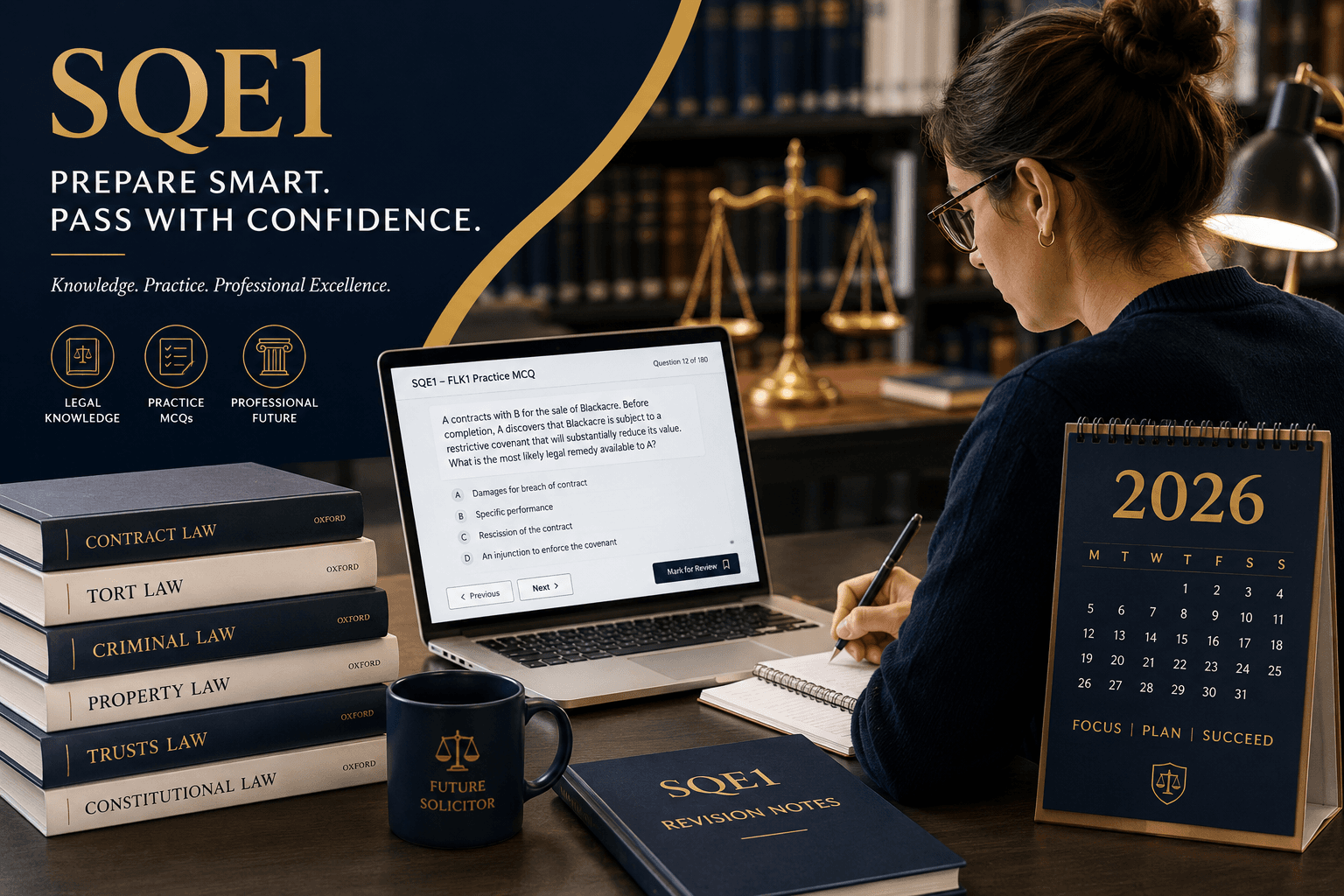
The Solicitors Qualifying Examination (SQE) has transformed the route to qualification as a solicitor in England and Wales. Since its introduction, candidates have adapted to a new style of assessment that places equal emphasis on legal knowledge, practical application, and professional judgment. As more aspiring solicitors enter the SQE pathway each year, preparation strategies continue to evolve.
While the core structure of SQE1 remains consistent, 2026 brings renewed attention to how candidates prepare, the resources they use, and the expectations of employers. Rather than relying solely on traditional revision techniques, many successful candidates are combining structured study plans, digital learning platforms, and extensive practice with single best answer multiple-choice questions.
This article examines the developments shaping SQE1 preparation in 2026, explains what has remained stable, highlights emerging study trends, and outlines practical steps candidates can take to maximise their chances of success.
Before relying on any exam-specific policy or timetable, candidates should always check the latest guidance published by the Solicitors Regulation Authority (SRA) and Kaplan, the SQE assessment provider.
Understanding SQE1
SQE1 assesses Functioning Legal Knowledge (FLK) across a broad range of legal subjects.
The assessment consists entirely of single best answer multiple-choice questions designed to test how candidates apply legal principles to realistic scenarios rather than simply recalling legislation.
The examination is divided into two assessments:
- FLK1
- FLK2
Together, these papers examine subjects including constitutional law, contract, tort, criminal law, business law, property law, dispute resolution, wills and administration of estates, trusts, ethics and professional conduct.
Unlike many university examinations, SQE1 demands consistent legal reasoning under considerable time pressure.
What Has Stayed the Same?
Although candidates often search for "major SQE1 changes," it is equally important to recognise what has remained stable.
The examination continues to focus on:
- Application of legal principles
- Ethical decision-making
- Practical legal scenarios
- Integrated legal knowledge
- Time management
Candidates who expect straightforward recall questions frequently underestimate the analytical nature of the assessment.
Success continues to depend on understanding how legal rules operate together rather than memorising isolated facts.
The Biggest Trend in 2026: Smarter Preparation
Perhaps the most noticeable development in 2026 is not the examination itself but how candidates prepare.
Traditional revision methods are increasingly being replaced by structured learning systems combining:
- Digital question banks
- Performance analytics
- Personalised revision schedules
- AI-assisted learning tools
- Timed mock examinations
Students increasingly track weak topics using detailed progress reports rather than relying on intuition.
This allows revision time to be allocated more efficiently.
Multiple-Choice Practice Has Become Even More Important
Every experienced SQE tutor agrees on one point.
Practice questions matter.
Reading textbooks alone is rarely sufficient.
The single best answer format tests subtle distinctions between similar legal principles.
Candidates who complete thousands of carefully designed practice questions generally become more confident at identifying distractor answers and spotting key legal issues under exam conditions.
High-quality question banks also expose students to a wide variety of realistic factual scenarios.
Ethics Is Never an Afterthought
Professional ethics remains integrated throughout SQE1.
Rather than appearing as a standalone topic, ethical considerations frequently arise within wider legal scenarios.
Candidates should therefore revise ethics alongside each substantive subject.
This reflects modern legal practice, where solicitors must constantly balance legal obligations with professional responsibilities.
Time Management Continues to Separate Candidates
Many candidates possess sufficient legal knowledge but struggle because they cannot answer questions quickly enough.
Effective time management begins long before exam day.
Successful students regularly complete full-length mock examinations under realistic conditions.
This develops familiarity with the pace required throughout both FLK assessments.
Technology Is Changing Revision
Technology has significantly influenced legal education.
Modern candidates increasingly use:
- Digital flashcards
- Interactive revision platforms
- Performance dashboards
- Mobile revision applications
- AI-assisted explanations
These tools should supplement—not replace—careful reading of legislation, legal principles and authoritative learning materials.
The Importance of Active Learning
Passive reading rarely produces lasting retention.
Research across education consistently suggests that active learning improves recall.
Candidates should consider:
- Answering practice questions before reading model explanations.
- Creating concise revision notes.
- Explaining difficult legal concepts aloud.
- Revisiting weaker topics regularly.
- Completing timed mock assessments.
Understanding the Breadth of the Syllabus
One of SQE1's greatest challenges remains its scope.
Candidates are expected to demonstrate knowledge across multiple areas of law.
This means revision plans should emphasise consistency rather than focusing exclusively on favourite subjects.
Even topics perceived as less significant can contribute meaningfully to the final assessment.
Common Mistakes Candidates Continue to Make
Memorising Without Understanding
Knowing legal rules is important.
Understanding when and why they apply is essential.
Ignoring Weaker Subjects
Strong candidates frequently maintain balanced preparation across the entire syllabus.
Avoid neglecting areas that seem unfamiliar.
Leaving Mock Exams Too Late
Mock examinations identify weaknesses while there is still time to improve.
Candidates should complete multiple full-length assessments before sitting the real examination.
Underestimating Fatigue
SQE1 demands sustained concentration.
Building exam stamina through regular timed practice remains one of the most valuable preparation strategies.
How Employers View SQE Candidates
Law firms increasingly recognise that passing SQE1 demonstrates resilience, disciplined study habits and strong analytical reasoning.
However, employers also value:
- Commercial awareness
- Communication skills
- Professional judgment
- Practical experience
Candidates should continue developing these qualities alongside examination preparation.
Building an Effective Revision Plan
An organised revision strategy often includes:
- Reviewing the syllabus.
- Dividing subjects into manageable sections.
- Completing daily practice questions.
- Reviewing incorrect answers carefully.
- Scheduling weekly mock assessments.
- Revising ethics throughout the course.
- Monitoring progress objectively.
Consistency is usually more effective than occasional intensive study sessions.
Looking Ahead
As legal education continues evolving, candidates can expect greater integration between technology and learning.
Digital learning platforms will likely become even more sophisticated.
Artificial intelligence may provide increasingly personalised revision support.
Nevertheless, no technology can replace a solid understanding of legal principles.
The strongest candidates will continue combining disciplined study, practical application and regular assessment.
Official Resources
Candidates should regularly consult official information to ensure they are working from the latest guidance:
- Solicitors Regulation Authority (SRA): https://www.sra.org.uk/become-solicitor/sqe/
- Kaplan SQE: https://sqe.kaplan.co.uk/
These resources provide the most up-to-date information on assessment arrangements, candidate guidance and examination administration.
Frequently Asked Questions
Has the SQE1 exam format changed in 2026?
At the time of writing, candidates should check the latest announcements from the SRA and Kaplan for any official updates to assessment arrangements. The core assessment continues to focus on Functioning Legal Knowledge through single best answer multiple-choice questions.
How many practice questions should I complete?
There is no fixed number, but regular exposure to high-quality questions under timed conditions is widely regarded as one of the most effective preparation methods.
Is ethics tested separately?
No. Ethics is integrated throughout SQE1 and should be revised alongside every substantive legal subject.
Should I rely only on AI study tools?
AI tools can help explain concepts and generate revision prompts, but they should complement—not replace—authoritative study materials, practice questions, and the official SQE specification.
Final Thoughts
Preparing for SQE1 in 2026 requires more than determination. It demands a structured approach, disciplined revision, and an understanding of how legal principles are applied in practice. While study methods continue to evolve with advances in technology, the fundamentals of success remain the same: build a strong grasp of the law, practise extensively with realistic questions, manage your time effectively, and keep an eye on official guidance from the SRA and Kaplan. Candidates who combine these elements place themselves in the strongest possible position for success.