If you are preparing for the SQE1, you have probably searched for one thing more than anything else: the pass rate. It is one of the most common concerns among candidates, and understandably so. The SQE has developed a reputation for being a demanding and highly selective assessment.
But raw statistics only tell part of the story.
To understand what your chances really look like—and how to improve them—you need to look beyond headline pass rates and analyse what the data actually reflects about the exam, candidate behaviour, and preparation strategies.
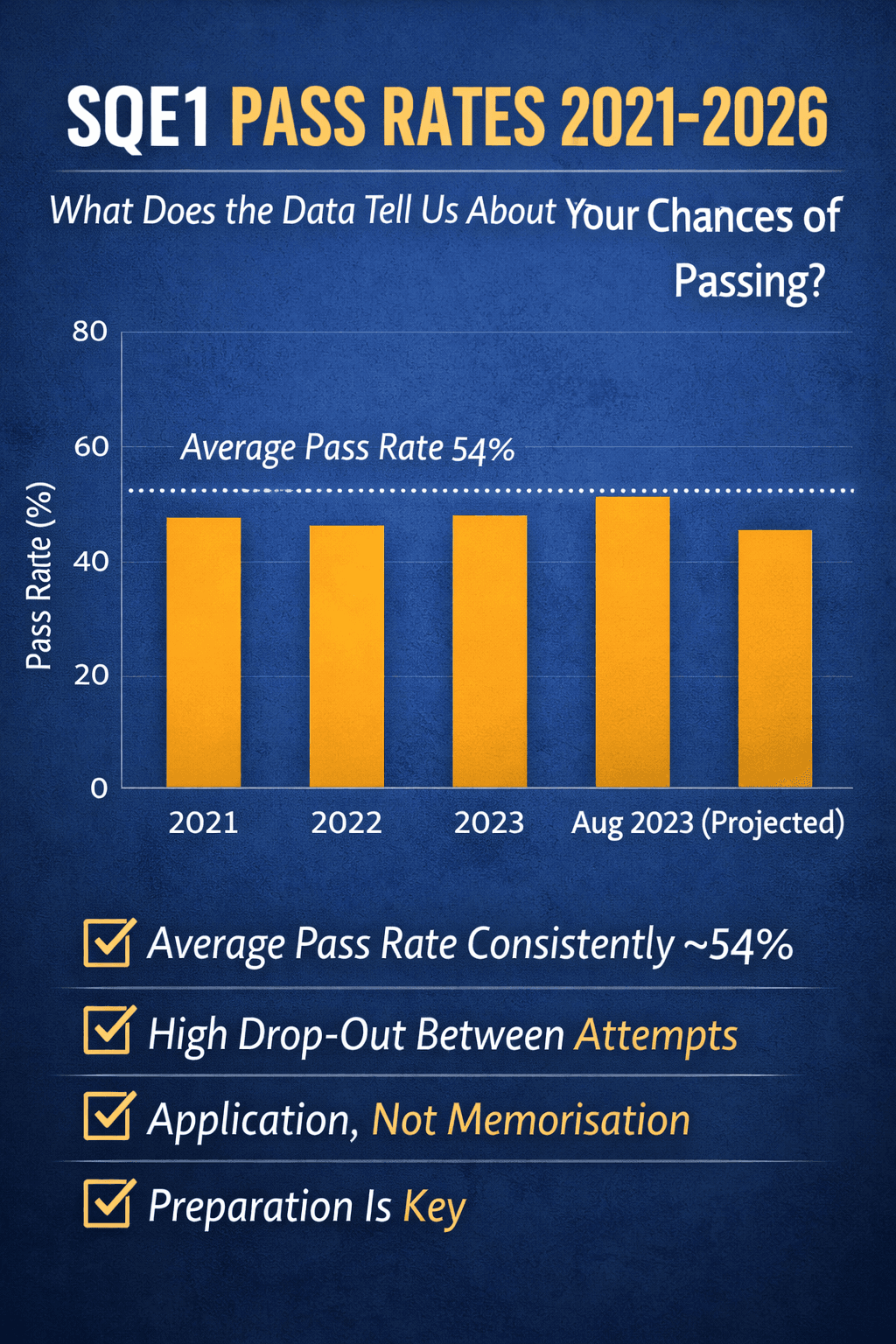
Since its introduction, the SQE1 has consistently produced pass rates that are lower than many candidates initially expect. Across sittings, the overall pass rate has typically ranged around the mid-50% mark, with some variation depending on the cohort.
At first glance, this can seem discouraging. However, the key point is that these statistics reflect a wide range of candidates with very different levels of preparation, backgrounds, and study approaches.
In other words, the pass rate is not simply a measure of exam difficulty—it is also a reflection of how candidates prepare.
A closer look at the data shows that performance varies significantly between different groups. Candidates who have completed structured preparation courses, engaged in consistent practice, and developed strong exam technique tend to perform considerably better than the overall average.
This suggests that the SQE1 is not an exam that rewards passive revision.
One of the most important trends emerging from SQE statistics is the gap between knowledge and application. Many candidates enter the exam with a solid understanding of legal principles but struggle to apply that knowledge effectively in single best answer questions.
This is reflected in the way questions are designed. The SQE1 tests functioning legal knowledge, meaning that it focuses on practical application rather than theoretical understanding. As a result, candidates who rely heavily on memorisation often underperform compared to those who prioritise practice and application.
Another key insight from the data is the impact of time pressure. With 360 questions across two assessments, candidates must maintain concentration and make decisions quickly over an extended period.
Statistics alone cannot capture this challenge, but candidate feedback consistently highlights time management as a major factor in performance.
Those who practise under timed conditions and develop efficient decision-making strategies are better equipped to handle the demands of the exam.
It is also important to consider the role of question design. SQE1 questions are carefully constructed to include plausible distractors—answers that may appear correct but are not the best option in the given scenario.
This contributes to lower pass rates because it tests precision rather than general knowledge. Candidates who are not familiar with this format are more likely to choose partially correct answers.
Interestingly, data from sample questions indicates that average candidate scores often hover just above 50%. This suggests that many candidates are performing at a borderline level, where small improvements in technique could make the difference between passing and failing.
This is an important point.
The SQE1 is not an exam where you need to achieve near-perfect accuracy. Instead, success depends on consistently selecting the best answer across a large number of questions.
This means that incremental improvements—such as better time management, improved elimination techniques, and more accurate application of rules—can have a significant impact on your overall result.
Another factor to consider is the breadth of the syllabus. The SQE1 covers a wide range of subjects, and it is not uncommon for candidates to feel stronger in some areas than others.
Statistics suggest that balanced performance across subjects is more important than excelling in a single area. Candidates who neglect certain topics may find that gaps in their knowledge affect their overall score.
Ethics and professional conduct also play a significant role. These principles are embedded throughout both FLK1 and FLK2, meaning that they can influence performance across multiple questions.
Candidates who overlook this aspect of the syllabus may find themselves losing marks unnecessarily.
So, what do these statistics mean for you as a candidate?
First, they highlight the importance of preparation strategy. Simply knowing the law is not enough. You need to develop the ability to apply that knowledge quickly and accurately in exam-style questions.
Second, they emphasise the value of consistent practice. Regular exposure to single best answer questions helps you understand how the exam works and improves your ability to identify the correct answer under pressure.
Third, they show that small improvements can make a big difference. Many candidates are close to the pass mark, and refining your technique can be enough to push you over the line.
Finally, they reinforce the importance of time management. Being able to work efficiently and maintain focus throughout the exam is essential for success.
It is also worth addressing a common misconception: that the SQE1 is “too difficult” to pass.
The statistics do not support this view. While the exam is undoubtedly challenging, the pass rate indicates that a significant proportion of candidates are successful. The key difference lies in how those candidates prepare.
Those who approach the exam strategically—focusing on application, practising regularly, and refining their technique—consistently achieve better outcomes.
As you prepare for the SQE1, it is important to use statistics as a guide rather than a source of anxiety. They provide useful insights into the nature of the exam, but they do not determine your individual outcome.
Your performance will depend on your preparation, your approach, and your ability to apply what you have learned.
In practical terms, this means focusing on high-impact activities. Prioritise practice questions, review your mistakes carefully, and ensure that you are comfortable with the exam format.
It also means maintaining a balanced approach to revision. Cover all areas of the syllabus, but allocate your time efficiently based on your strengths and weaknesses.
As the exam approaches, shift your focus towards refining your technique. Practise under timed conditions, complete mock exams, and work on improving your accuracy.
Ultimately, the SQE1 is a test of consistency and application. The statistics show that many candidates are capable of passing, but success depends on how effectively you prepare.
If you take a strategic approach, use the data to inform your revision, and focus on developing the skills required for the exam, you can significantly improve your chances of success.