There is a particular kind of fatigue that does not announce itself with drama. It does not arrive as a crisis, nor as a sudden collapse. Instead, it accumulates quietly—through late-night revision sessions, through the mechanical clicking of multiple-choice answers, through the creeping suspicion that no amount of preparation is ever quite enough. By the time many candidates recognise it, burnout has already taken hold.
In the context of Solicitors Qualifying Examination preparation, burnout is not simply a matter of working too hard. It is structural, almost engineered into the experience. To understand it properly, one must first understand the nature of the assessment itself—and the peculiar psychological demands it imposes.
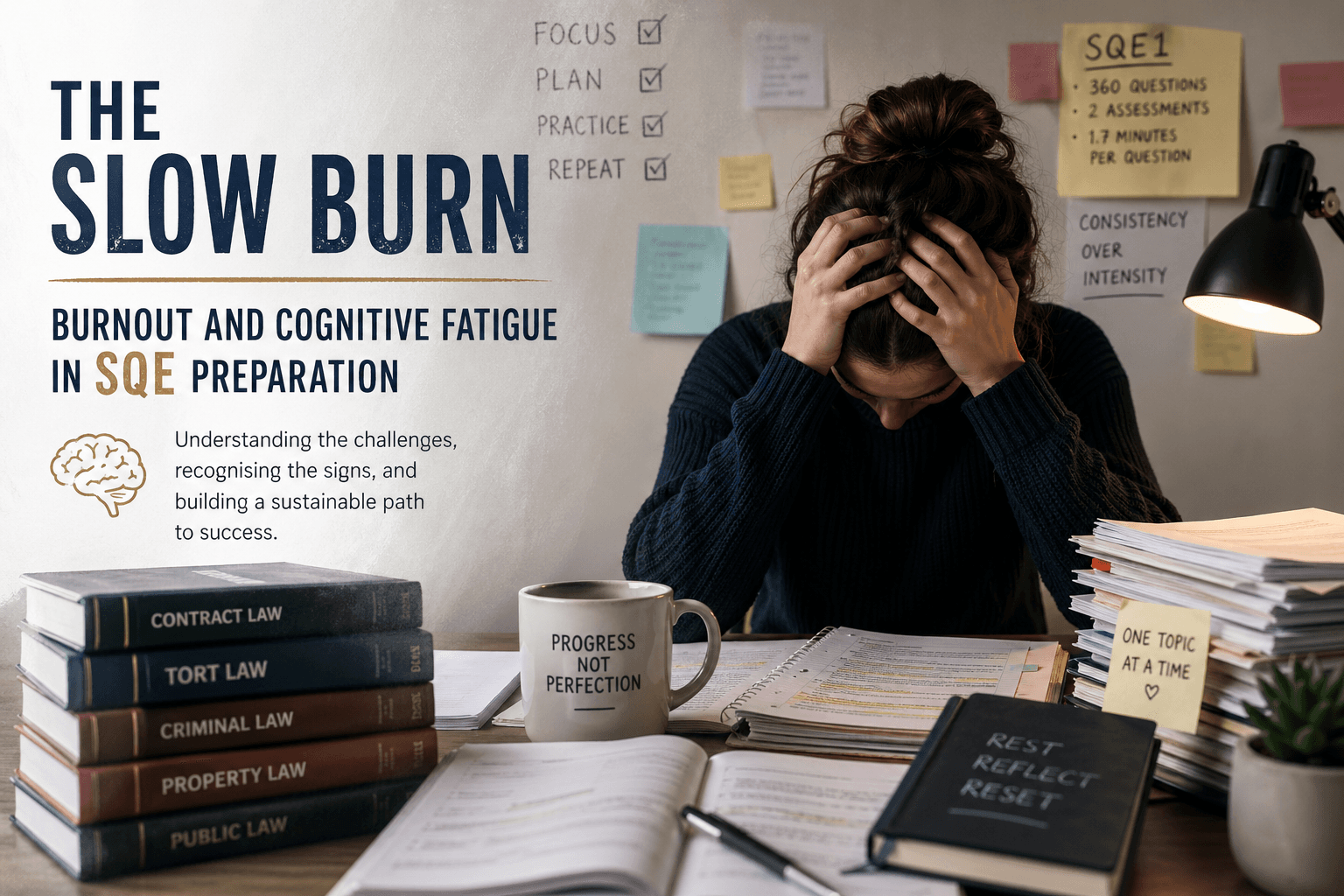
The SQE1 is not an examination that rewards surface familiarity. It demands the application of functioning legal knowledge across a breadth that is, by any measure, formidable. Candidates are expected to navigate 360 single best answer questions across two assessments, each conducted under strict time constraints. At approximately 1.7 minutes per question, the rhythm is relentless, leaving little room for reflection or recovery .
This is not simply a test of knowledge. It is a test of sustained cognitive performance under pressure. And therein lies the problem.
The Architecture of Exhaustion
What distinguishes SQE burnout from the more familiar fatigue of academic study is its cumulative and multi-layered nature. It is not just about hours spent revising. It is about the type of mental effort required.
The SQE1’s multiple-choice format—deceptively straightforward at first glance—demands continuous micro-decisions. Each question requires the candidate to identify subtle distinctions between plausible answers, often across areas of law that intersect unpredictably. The cognitive load is constant. There is no safe territory, no predictable pattern to rely on.
Over time, this produces a form of decision fatigue. The brain, repeatedly forced to evaluate nuanced legal scenarios at speed, begins to degrade in its efficiency. Candidates report a familiar pattern: early revision sessions feel productive, even energising; later ones become sluggish, marked by second-guessing and diminished confidence.
This is not a failure of discipline. It is a predictable neurological response.
Layer onto this the breadth of the syllabus—spanning everything from contract and tort to land law and criminal liability—and the problem intensifies. Unlike traditional law exams, which often allow for depth within narrower modules, the SQE demands breadth with precision. The result is a persistent sense of incompleteness. There is always another topic that could be tested, another nuance that might be missed.
Burnout, in this context, is less about overwork and more about unresolved cognitive tension.
The Illusion of Productivity
One of the more insidious aspects of SQE preparation is the way it rewards the appearance of productivity over its substance.
Consider the typical revision strategy: endless banks of practice questions, repeated cycles of mock exams, flashcards, summary notes. On the surface, this looks like effective preparation. It is active, measurable, and aligned with the format of the assessment.
But there is a point—often reached without realising it—where this activity becomes performative. Candidates continue to complete questions not because they are learning, but because stopping feels like failure. The feedback loop becomes distorted: more effort does not necessarily translate into better performance, yet the instinct is to double down.
This is where burnout deepens. The candidate is no longer studying to improve; they are studying to maintain control.
Psychological Compression and the Loss of Perspective
There is also a temporal dimension to SQE burnout that deserves attention. Preparation for the exam often occurs alongside other pressures: qualifying work experience, financial constraints, and the uncertainty of future employment.
The result is a kind of psychological compression. The exam begins to dominate the candidate’s sense of time. Weeks blur into one another. Progress becomes difficult to measure. Small setbacks—an unexpectedly low mock score, a difficult topic—take on disproportionate significance.
In this compressed environment, perspective is easily lost. The exam is no longer one step in a broader professional journey; it becomes the defining obstacle. Burnout thrives in this narrowing of focus.
The Role of Uncertainty
Unlike more traditional routes into the profession, the SQE is still, in many respects, a relatively new assessment. Its evolving nature introduces an additional layer of uncertainty. Candidates are preparing not just for a demanding exam, but for one whose patterns and expectations are still being interpreted.
The official sample materials—valuable though they are—cannot fully replicate the experience of the live assessment. They illustrate the style and standard of questions, but they cannot capture the cumulative effect of answering 180 questions in a single sitting, twice over .
This gap between preparation and reality contributes to a persistent anxiety: Am I preparing in the right way? It is a question that rarely receives a definitive answer, and its presence is a constant drain on mental energy.
Recognising Burnout Before It Peaks
One of the challenges with burnout is that it is often identified too late. By the time candidates acknowledge it, their performance has already been affected.
Yet the early signs are consistent. A decline in concentration. An increase in careless mistakes. A growing aversion to study sessions that were once manageable. Perhaps most tellingly, a shift in emotional tone—from engaged curiosity to detached obligation.
These are not signs of inadequacy. They are signals that the current approach is unsustainable.
Reframing Preparation: From Volume to Precision
If burnout is, in part, a product of how candidates prepare, then addressing it requires a shift in strategy.
The instinctive response to a demanding syllabus is to increase volume: more hours, more questions, more notes. But beyond a certain point, this becomes counterproductive. The marginal benefit of additional effort diminishes, while the psychological cost continues to rise.
A more effective approach is to prioritise precision over volume. This means engaging more deeply with fewer materials. It means analysing errors rather than simply noting them. It means recognising that not all topics carry equal weight, and that strategic focus is not a weakness but a necessity.
Crucially, it also means allowing for cognitive recovery. The brain requires periods of rest to consolidate information. Without this, learning becomes superficial, and burnout accelerates.
The Cultural Dimension
There is also a broader cultural issue at play. Within legal education, there remains a tendency to valorise endurance. Long hours, relentless study, the ability to push through fatigue—these are often treated as markers of commitment.
In the context of the SQE, this mindset is particularly dangerous. It encourages candidates to ignore the very signals that would allow them to adjust their approach. Burnout, in this culture, is not seen as a warning but as an inevitability.
This needs to change. Endurance is not the same as effectiveness.
Towards a More Sustainable Model
What, then, does sustainable SQE preparation look like?
It is not a fixed formula. But certain principles emerge consistently: structured variation in study tasks, realistic simulation of exam conditions, clear boundaries around study time, and attention to physical and mental health.
Preparation is not purely intellectual. Sleep, nutrition, and recovery are integral to performance—especially in an assessment that tests stamina as much as knowledge.
Conclusion: Beyond Survival
Burnout during SQE preparation is not a personal failing. It is a predictable response to an assessment that demands sustained, high-level cognitive effort across a vast syllabus, under significant time pressure.
The challenge is not simply to endure this process, but to navigate it intelligently. To recognise when effort becomes counterproductive. To prioritise quality over quantity. To maintain perspective in the face of uncertainty.
Ultimately, the goal is not just to pass the SQE. It is to emerge from the process with the capacity to practise law effectively. That requires more than knowledge. It requires resilience—but a resilience that is strategic, not self-destructive.