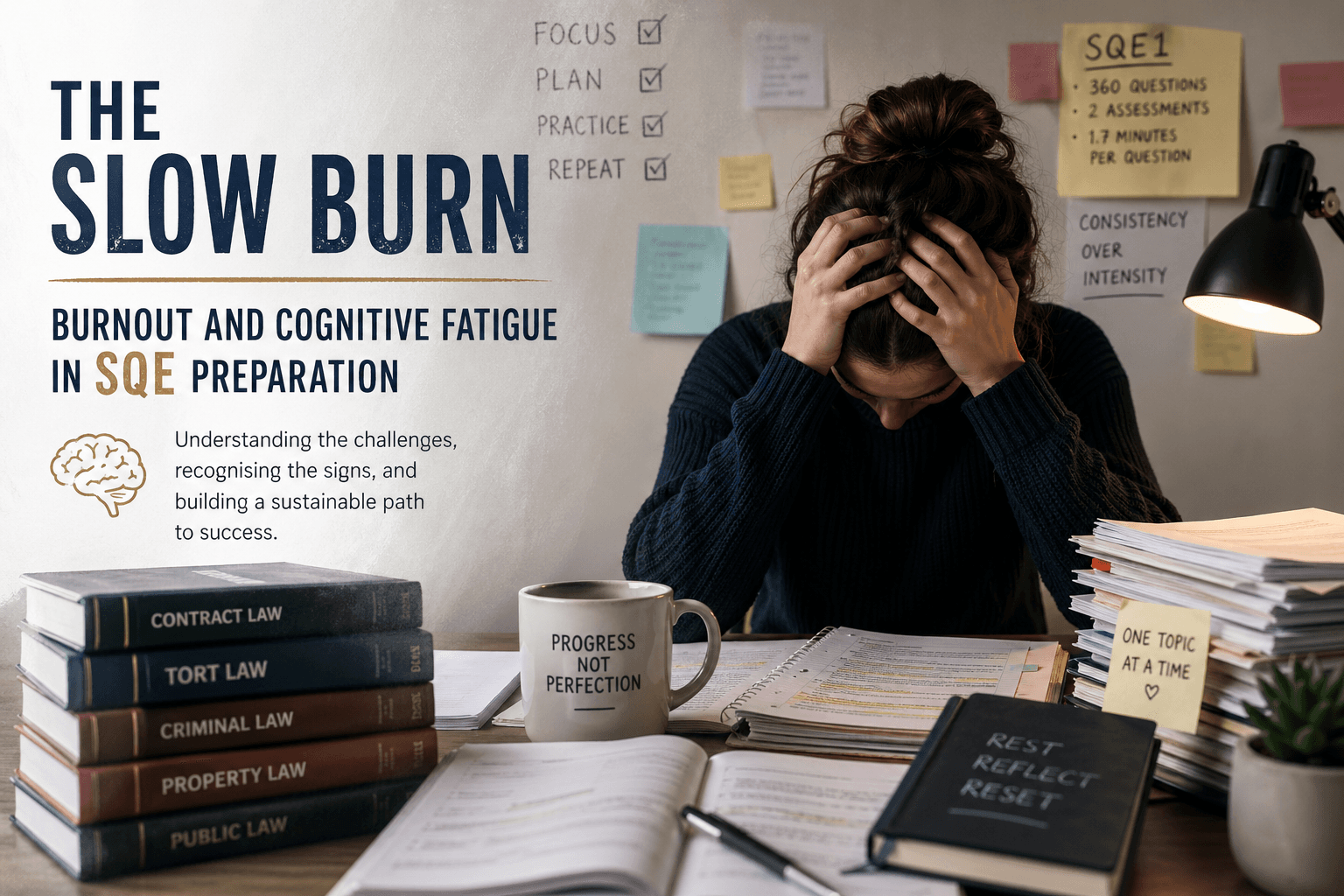
If you ask candidates who have successfully passed SQE1 what made the biggest difference in their preparation, the answer is almost always the same: consistent practice with Single Best Answer (SBA) questions.
While many candidates focus heavily on reading textbooks and revising notes, those who perform well understand that SQE1 is not just about knowing the law—it is about applying it quickly and accurately under exam conditions.
This is why practising questions daily is one of the most effective strategies you can adopt.
The SQE1 exam is designed to test functioning legal knowledge across a wide range of subjects. However, it does so through a very specific format: multiple-choice questions based on realistic scenarios. This means that success depends on your ability to interpret facts, identify legal issues, and select the best answer from several plausible options.
Reading alone cannot develop this skill.
When you practise questions regularly, you begin to understand how the exam works. You see how topics are tested, how questions are structured, and how distractors are used to challenge your understanding.
Over time, this exposure builds familiarity and confidence.
One of the key benefits of daily practice is pattern recognition. Certain legal principles appear repeatedly in different forms. For example, in contract law, you may encounter multiple questions on offer and acceptance, consideration, or misrepresentation. In land law, priority rules and registration are common themes.
By practising regularly, you start to recognise these patterns and approach similar questions more efficiently.
Another advantage is improved speed. The SQE1 exam is highly time-pressured, with an average of approximately 1.7 minutes per question. Without regular practice, it is difficult to develop the pace required to complete the exam comfortably.
Daily practice helps you build this speed gradually.
It also improves your decision-making under pressure. In many questions, more than one answer may appear correct. The challenge is to identify the best answer based on the specific facts provided.
This requires not only knowledge but also judgment.
Practising questions regularly trains you to make these decisions more effectively. You learn to eliminate incorrect options quickly and focus on the most relevant answers.
Importantly, daily practice also highlights gaps in your knowledge. When you get a question wrong, it provides immediate feedback on areas that need improvement. This allows you to focus your revision more efficiently.
Instead of revising everything equally, you can target weaker areas and strengthen your understanding where it matters most.
However, simply doing questions is not enough. The real value comes from reviewing your answers carefully.
After each practice session, take the time to analyse both correct and incorrect answers. Understanding why an answer is correct is just as important as understanding why others are wrong.
This deeper level of analysis reinforces your learning and helps you avoid similar mistakes in the future.
A structured approach to daily practice can be particularly effective. For example, you might begin with a set number of questions each day, focusing on a specific topic. After completing the questions, review your answers and make notes on key points.
Over time, you can increase the number of questions and begin mixing topics to simulate exam conditions.
Another important aspect is consistency. Short, regular practice sessions are far more effective than occasional, intensive study periods. Even 20–30 questions per day can make a significant difference over time.
Consistency builds momentum and helps reinforce your learning.
It is also important to practise under timed conditions. This helps you develop the ability to work efficiently and manage your time during the exam. As you become more comfortable with the format, you will find that your speed and accuracy improve naturally.
Many candidates also benefit from tracking their progress. Keeping a record of your scores and performance across different topics can help you identify trends and measure improvement.
For example, you may notice that your accuracy in certain subjects is lower than others. This allows you to adjust your revision plan and focus on areas that need more attention.
Confidence is another key benefit of daily practice. The more questions you attempt, the more familiar the format becomes. This reduces anxiety and helps you approach the exam with a clearer mindset.
Confidence does not mean certainty in every answer. Rather, it means being comfortable making informed decisions even when you are unsure.
It is also worth noting that the SQE1 exam is not designed to test obscure or highly specialised knowledge. Instead, it focuses on core legal principles and their application.
This means that practising questions on these core topics can have a significant impact on your overall performance.
As the exam approaches, your focus should shift towards refining your technique. This includes practising mixed-topic questions, completing full mock exams, and reviewing key areas.
At this stage, daily practice becomes even more important. It helps reinforce your knowledge, improve your accuracy, and ensure that you are fully prepared for the exam.
Ultimately, the candidates who pass SQE1 are those who train for the exam itself. They do not rely solely on passive revision methods. Instead, they actively engage with the material through practice and application.
If you are serious about passing SQE1, make daily question practice a core part of your routine.
It is one of the most effective ways to improve your performance and maximise your chances of success.