One of the biggest challenges candidates face when preparing for the SQE1 is not the volume of content, but the format of assessment. The Single Best Answer (SBA) question style is unfamiliar to many law graduates, and it requires a very different approach compared to traditional essay-based exams.
Many candidates assume that knowing the law is enough. However, SQE1 is designed to test how effectively you can apply legal knowledge in realistic, time-pressured scenarios. This means that exam technique is not optional—it is essential.
Understanding how SBA questions work is the first step towards improving your performance.
Each question presents a scenario, often involving a client situation, transaction, or dispute. You are then asked to identify the correct legal position or provide the best advice. The key word here is “best.” Multiple options may appear correct, but only one fully addresses the specific facts of the scenario.
This is where many candidates lose marks.
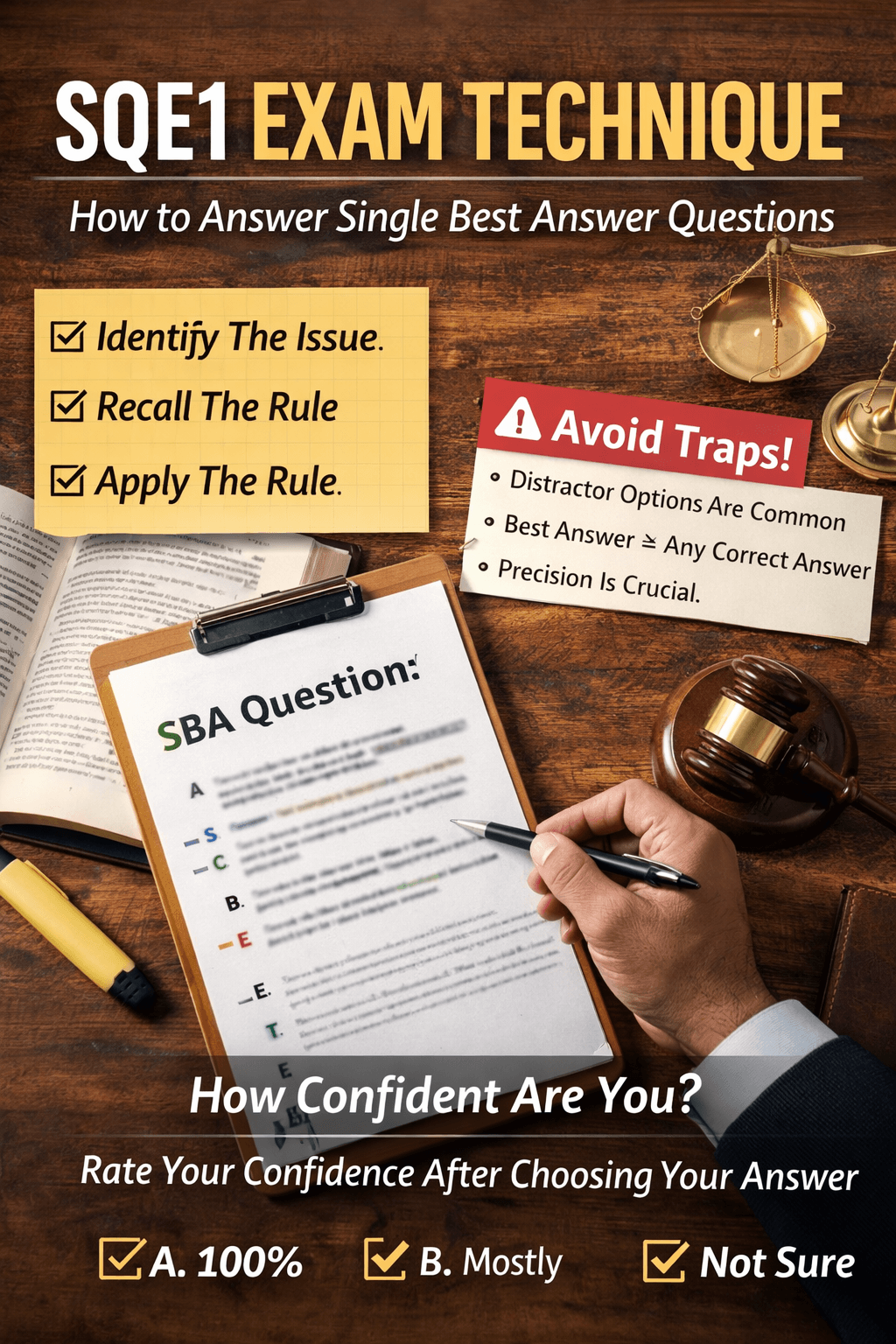
A common mistake is to select the first answer that looks correct without fully analysing the question. In SBA exams, this approach is risky. The examiners deliberately include distractors—answers that are partially correct or reflect common misunderstandings.
To avoid this, you need a structured approach to every question.
The most effective method is to break the question down into three stages: identify the issue, recall the rule, and apply the rule to the facts.
First, read the question carefully and identify the key legal issue. This may require reading the scenario more than once. Pay close attention to details such as dates, relationships, and specific wording. These details often determine which rule applies.
Second, recall the relevant legal rule. This should be done before looking at the answer options. By doing this, you reduce the risk of being influenced by incorrect answers.
Third, apply the rule to the facts of the scenario. Ask yourself which option best fits the situation described. This step is crucial because the correct answer is always the one that aligns most precisely with the facts.
Elimination is another powerful technique. Instead of trying to identify the correct answer immediately, start by ruling out options that are clearly wrong. This reduces the number of choices and makes it easier to focus on the remaining options.
Often, you will be left with two plausible answers. At this stage, the correct choice will usually depend on a subtle distinction. It could be a timing issue, a procedural requirement, or a specific legal principle that only applies in certain circumstances.
Developing the ability to spot these distinctions is key to success.
Time pressure adds another layer of difficulty. With approximately 1.7 minutes per question, you cannot afford to spend too long on any single question. If you are unsure, make your best judgment, flag the question, and move on.
There is no negative marking in SQE1, so it is always better to attempt every question.
Another important aspect is recognising common traps. These include answers that are legally correct in general but do not apply to the specific facts, answers that misstate a rule slightly, or answers that focus on irrelevant details.
For example, in contract law, a question may involve offer and acceptance. One option might correctly state the general rule but fail to account for a counter-offer in the scenario. Selecting that option would be incorrect, even though the rule itself is accurate.
This highlights the importance of applying the law, not just recognising it.
Practice is the most effective way to improve your SBA technique. The more questions you attempt, the more familiar you become with the style of questioning and the types of traps used by examiners.
However, practice alone is not enough. You must also review your answers carefully. Understanding why an answer is correct or incorrect is essential for improvement.
When reviewing questions, focus on the reasoning behind the correct answer. Ask yourself what made it the best choice and why the other options were less suitable. This deeper level of analysis helps reinforce your understanding and improves your ability to apply the law in future questions.
It is also helpful to track your performance across different topics. This allows you to identify areas of weakness and focus your revision more effectively.
Consistency is key. Regular, focused practice sessions are far more effective than occasional, intensive study periods. Over time, this builds both knowledge and confidence.
Confidence plays a significant role in SBA exams. You need to be comfortable making decisions under uncertainty. This does not mean guessing randomly, but rather making informed choices based on your understanding of the law and the facts.
Another factor to consider is mental fatigue. The SQE1 exams are long and demanding, requiring sustained concentration. Building your stamina through timed practice sessions can help you maintain performance throughout the exam.
Mock exams are particularly valuable in this regard. They allow you to experience the pressure of the real exam and refine your time management strategy.
It is also important to maintain a balanced approach to revision. While practising questions is crucial, you still need a solid understanding of the underlying legal principles. The goal is to integrate knowledge and technique.
As the exam approaches, your focus should shift towards refining your technique rather than learning new material. This includes practising under timed conditions, reviewing key topics, and ensuring that you are comfortable with the exam format.
Ultimately, success in SQE1 is about consistency. You do not need to answer every question perfectly. Instead, aim to perform well across the board and avoid unnecessary mistakes.
By developing a structured approach to SBA questions, practising regularly, and learning from your mistakes, you can significantly improve your performance.
The candidates who pass are not necessarily those who know the most law, but those who can apply their knowledge effectively under pressure.