The Great SQE Gamble: Why Traditional Law Revision is Failing the 2026 Candidate
The English legal profession has always loved a baptism by fire. For decades, that fire was the Legal Practice Course (LPC) — an eye-wateringly expensive hurdle that tested a candidate's ability to lug heavy textbooks across London and regurgitate boilerplate clauses under duress. But the Solicitors Regulation Authority (SRA) decided that wasn't quite egalitarian enough. Enter the Solicitors Qualifying Examination (SQE).
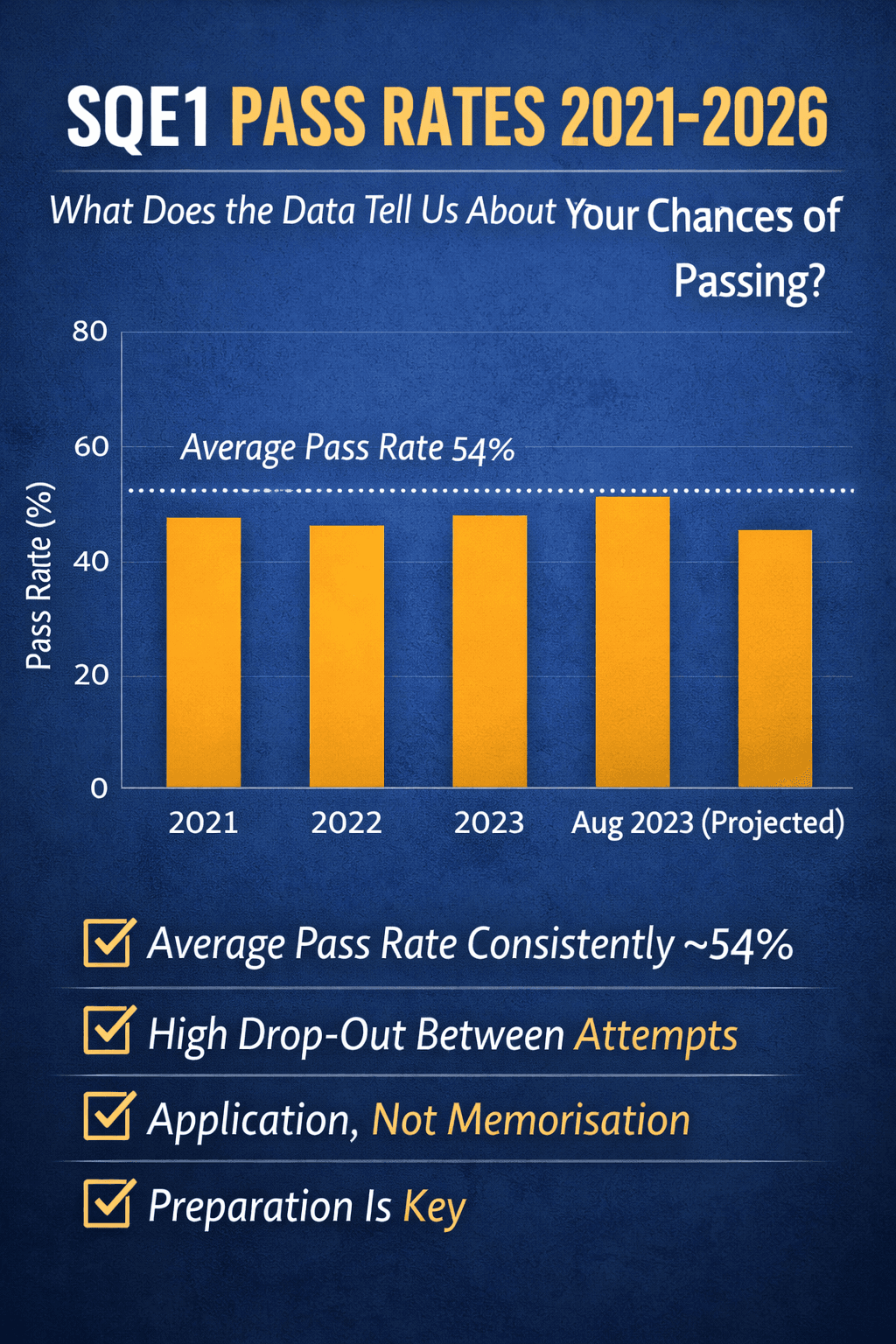
Billed as the great democratiser of legal qualification, the SQE was supposed to level the playing field. Yet, as we sit deep into 2026, the data tells a rather different story. The pass rates for SQE1 frequently hover in the low 50s, leaving thousands of capable, ambitious graduates wondering where it all went wrong.
The blunt truth? The old rote-learning playbook that got you a first-class LLB will actively drag you down in the SQE. If you are sitting in a library right now, endlessly highlighting your notes on the rule against perpetuities, you are playing the wrong game.
The Death of the LPC and the Birth of the Super-Exam
To understand why candidates are failing, you have to understand the architectural shift orchestrated by the mandarins at Chancery Lane. The LPC was a known quantity. Law firms understood it; candidates knew how to cram for it. It was a test of broad competence, heavily subsidised by City firms for their future trainees.
The SQE, however, is a different beast entirely. It strips away the comfort of open-book exams and replaces them with a brutal, closed-book assessment of Functioning Legal Knowledge (FLK).
Before we dissect exactly how the examiners set their traps, it is worth looking at exactly how the new regime compares to the old.
| Feature | LPC Route | SQE Route |
|---|---|---|
| Entry Degree | Qualifying Law Degree (QLD) or GDL | Any degree (or equivalent level 6 qual) |
| Route Structure | Highly structured & sequential | Non-sequential; exams can vary |
| Exam Format | Modular, often open-book | SQE1 (MCQ) & SQE2 (Practical skills) |
| Testing Style | Provider-specific exams | Centrally set, closed-book |
| Training Mode | 2-year formal Training Contract | 2-year Qualifying Work Exp. (QWE) |
| Provider Limit | Usually single firm/org | Up to 4 separate organisations |
| Career Path | Rigid bottleneck (TC scarcity) | High flexibility; earn while learning |
The takeaway: The SQE has decoupled the exams from the work experience. You no longer need a magic circle firm to hand you a training contract to qualify — but you do need to pass an exam that takes no prisoners.
The Anatomy of an SBAQ Trap
The fundamental misunderstanding of SQE1 is that it is a "multiple-choice exam". When the British public hears "multiple choice," they think of driving theory tests or pub quizzes. The SRA, conversely, uses Single Best Answer Questions (SBAQs).
In a standard multiple-choice question, three answers are glaringly wrong and one is right. In an SBAQ, all five options might be legally correct statements in a vacuum. Your job is not to find the correct law; your job is to find the best application of the law to a hyper-specific, meticulously engineered factual matrix.
This is where the examiner's trap snaps shut. Let’s break down how they do it.
1.The Red Herring Fact: Saturating the candidate's cognitive load.
The vignette will introduce a compelling but legally irrelevant detail. For example, in a tort claim about negligence, the examiner will spend three sentences describing the claimant's pre-existing back condition. You immediately start calculating thin-skull rule implications. You waste two minutes. The actual question ends up being about whether a duty of care was owed in the first place.
2.The 'Almost Right' Distractor: Punishing surface-level memorisation.
Option B will look perfect. It correctly cites the relevant statute and applies it logically to the facts. But it misses a tiny procedural exception buried in the Civil Procedure Rules (CPR) that applies because the claim is under £10,000. If you rely on general principles, you will select B and feel smug about it. You will be wrong.
3.The Fatal Qualifier: The difference between 'must' and 'may'.
Option D and Option E will be virtually identical. The only difference will be a single modal verb. Does the court have to grant the injunction, or does it have discretion to do so? This tests whether you actually understand the mechanics of the remedy, rather than just its existence.
This is not a test of memory. It is a test of legal triage under extreme time pressure.
The Brutal Reality of Pearson VUE
Let us talk about the environment. The Solicitors Qualifying Examination is not sat in a wood-panelled hall at your university. You will sit FLK1 and FLK2 in a Pearson VUE test centre — the same bleak, strip-lit rooms where people take their plumbing certification or HGV theory tests.
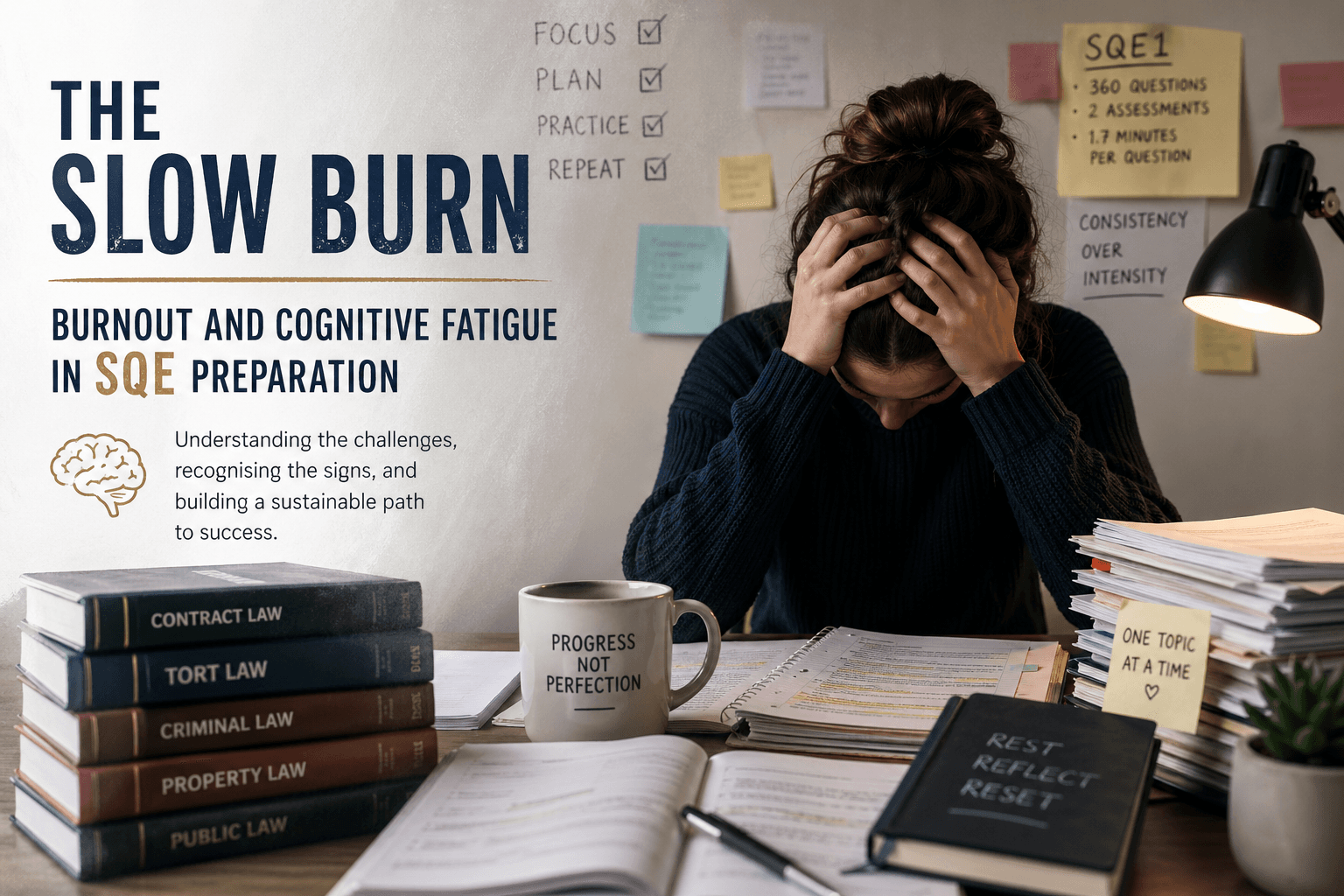
You will face 180 questions per day, split into two blocks of 2 hours and 33 minutes. That gives you roughly 1.7 minutes per question.
Cognitive fatigue is not just a risk here; it is a guaranteed physiological reality. By question 140, the words on the screen will begin to blur. Your brain will aggressively push you towards the path of least resistance — picking the answer that "looks about right" just to make the screen go away.
This is why traditional revision fails. You can read Blackstone's until your eyes bleed, but reading does not build the specific cognitive endurance required to process complex SBAQs for five hours straight.
The QWE Wild West
We cannot discuss the SQE without touching upon Qualifying Work Experience (QWE). In replacing the highly regulated Training Contract, the SRA created a free-for-all. You can now accrue your two years of QWE at up to four different organisations — paralegal work, law clinics, citizens advice bureaus.
It sounds fantastically flexible. In practice, it has created a two-tier system. City firms are openly stating that while a piecemeal QWE portfolio makes you legally a solicitor, it does not necessarily make you a commercial solicitor they want to hire.
Consequently, your SQE1 score has taken on disproportionate weight. It is the only objective, standardised metric law firms have left to compare a candidate who spent two years paralegalling at a high street family practice with a candidate who did a structured graduate apprenticeship at Clifford Chance.
You do not just need to pass the SQE1. If you want a competitive job in the City, you need to comfortably clear the pass mark to prove your academic rigour hasn't been diluted by the new system.
How to Beat the Examiner at Their Own Game
If rote learning is dead, what replaces it? Active retrieval and pattern recognition.
The only proven way to pass an exam built on SBAQs is to subject yourself to SBAQs relentlessly. This is not about testing what you know; it is about calibrating your brain to the frequency of the examiner.
- Volume is vanity; analysis is sanity. Doing 100 mock questions in a day is useless if you don't review them. You need to spend twice as long reviewing a question as you did answering it. Why was option C the best answer? Why was option A legally correct but factually wrong?
- Respect the blueprint. The SRA publishes a detailed assessment specification. FLK1 covers Business Law, Dispute Resolution, Contract, Tort, Legal System, and Public Law. FLK2 covers Property, Wills, Criminal Law, and Solicitors Accounts. Do not over-index on Contract Law just because you enjoyed it at university while ignoring Solicitors Accounts, which is notoriously heavily weighted and punishingly exact.
- Simulate the environment. Practice under timed, closed-book conditions. The first time you experience the pressure of a ticking clock should not be in a Pearson VUE centre.
This is precisely the gap platforms like SQEMCQ are filling. By providing a massive bank of questions mapped directly to the SRA blueprint, the platform forces you out of passive reading and into the uncomfortable, highly effective zone of active application. It isn't just about learning the law; it's about learning the exam.
The SQE is an unforgiving gatekeeper. It does not care about your university pedigree, and it certainly does not care how beautifully highlighted your revision notes are. It cares only whether you can identify the single best legal truth in a sea of plausible lies, in under 102 seconds.
Stop reading. Start practising.